
Emergency Air Duct Cleaning Near Me: What Redondo Beach Homeowners Should Do First
If you’re searching for “emergency air duct cleaning near me” in Redondo Beach, the first thing to do is not actually cleaning. It’s shutting your HVAC system off at the thermostat, then identifying what’s in the ducts. Three situations justify an urgent call: rodent activity you can hear or smell, smoke contamination from a nearby fire, or sewage-adjacent odor moving through the vents. Each one needs a containment-first response, not just an aggressive scrub. If you’d rather not deal with this yourself, call (877) 358-4828 and we’ll walk you through it.
Why “Emergency” Duct Cleaning Is Usually the Wrong First Call
Most Redondo Beach homeowners call us after they’ve already spent an hour searching for someone who can come out immediately. That’s understandable. But here’s what we’ve learned over nine years of doing this: the word “emergency” gets applied to a lot of situations that are actually urgent maintenance, and it gets skipped entirely for situations that genuinely require immediate containment. The distinction matters because the response is different.
A true duct emergency in Redondo Beach nearly always involves a contamination source that is still active. That means rodent nesting material inside the branch lines. Or smoke particulate from a structure fire or wildfire event that has been pulled into the return side of the system. Or, less commonly but worse, a sewage gas odor that indicates a dried-out trap or a breached drain line feeding into the air stream. In each case, running the blower motor while you wait for a technician spreads the contaminant further into the duct network. The first move is system lockout: turn the thermostat to “off,” then flip the breaker for the air handler if you can identify it. This physically prevents the fan from cycling, even on a timed schedule.
We sometimes get calls from homeowners who have already had a handyman out with a shop vac. That’s the worst outcome, because agitating nesting material or soot without HEPA containment puts more of it into your living space than was there before. True source-removal requires a negative-pressure setup, not a consumer vacuum. If you’re in the coastal neighborhoods near the Redondo Beach pier or up in the hills off Prospect, rodent pressure is consistent enough that we treat every urgent call as a potential contamination event until proven otherwise.
Here’s the sequence we recommend for any genuine HVAC emergency in Redondo Beach:
- Turn the system off at the thermostat. Then kill the breaker for the air handler.
- Do not open the supply registers and start poking around. If it’s a rodent issue, you’ll aerosolize dried waste.
- Identify the source. Is the smell coming from one room or the entire house? One room suggests a localized issue. Whole-house suggests contamination at the return or main trunk line.
- Photograph everything visible. Keep your phone camera ready. If it’s an insurable event, pre-cleaning documentation matters.
- Call a contractor who talks about containment before price. If the first thing they quote is a square-footage price and they haven’t asked what the contaminant is, that’s a red flag.
Rodent Intrusion: Why Cleaning Without Sealing Is Pointless
Roof rats are endemic in the Beach Cities. They’re agile, they follow tree lines and power lines, and they find their way into attic spaces and crawl spaces with surprising speed. Once inside, they move through duct runs that are compromised at the seams or disconnected at the transitions. What a Redondo Beach homeowner notices first is usually the sound: scratching in the ceiling near the return plenum, or a sudden, localized smell that comes and goes with the fan cycle.
This is a situation where arranging an air duct cleaning appointment without addressing the entry point is a wasted service call. The cleaning crew can remove every trace of nesting material, run the full source-removal process, and leave the system biologically clean. And it won’t matter if the rat can walk back in through a three-inch gap where the duct boot meets the ceiling register. We see this constantly in homes around the older neighborhoods of Redondo Beach, where retrofitted HVAC often has transitions that were never properly sealed from day one.
The correct sequence is assessment first, then exclusion, then cleaning, then sealing. On a typical urgent rodent job, that means tracing the interior run from the return all the way to the farthest supply, checking for droppings at each accessible seam, and identifying whether the nesting site is actually inside the ductwork or just adjacent to it. If it’s adjacent, air cleaning alone won’t fix the smell that’s being drawn in through a leaky return. The repair side of the job is the part that keeps the problem from returning in six weeks.
What should you expect from a legitimate response? A technician should arrive with a HEPA vacuum system, not a standard wet-dry vac. They should talk about the difference between cleaning the interior surfaces and removing what’s living in them. And they should be prepared to discuss the repair work that follows: replacing damaged flex duct, sealing connections with mastic, and possibly replacing a section of the main trunk if it’s been chewed through. If the person on the phone doesn’t mention rodents as a possibility when you describe the smell, consider that a sign you’re talking to a duct cleaner who only knows how to clean.
Smoke and Soot: What Actually Removes Submicron Particles
The smell of smoke coming through your vents in Redondo Beach is usually one of two things: residue from a nearby structure fire, or dust burning off the heat exchanger the first time the furnace cycles in cooler weather. The second one is harmless and goes away within an hour. The first one is a contamination event, and treating it with a standard cleaning is the most common mistake we see.
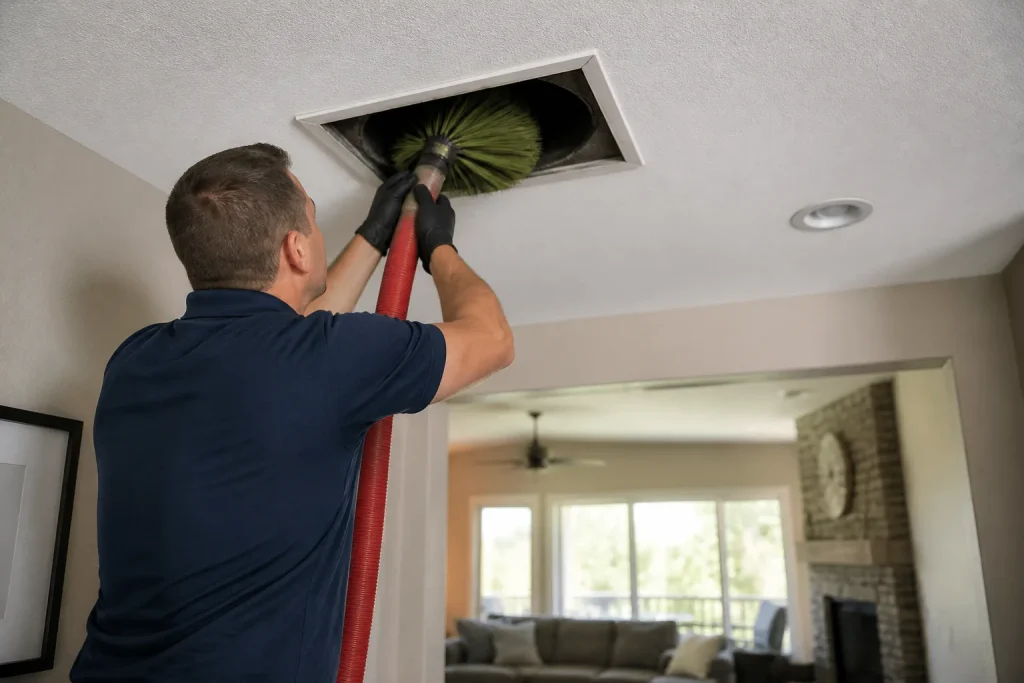
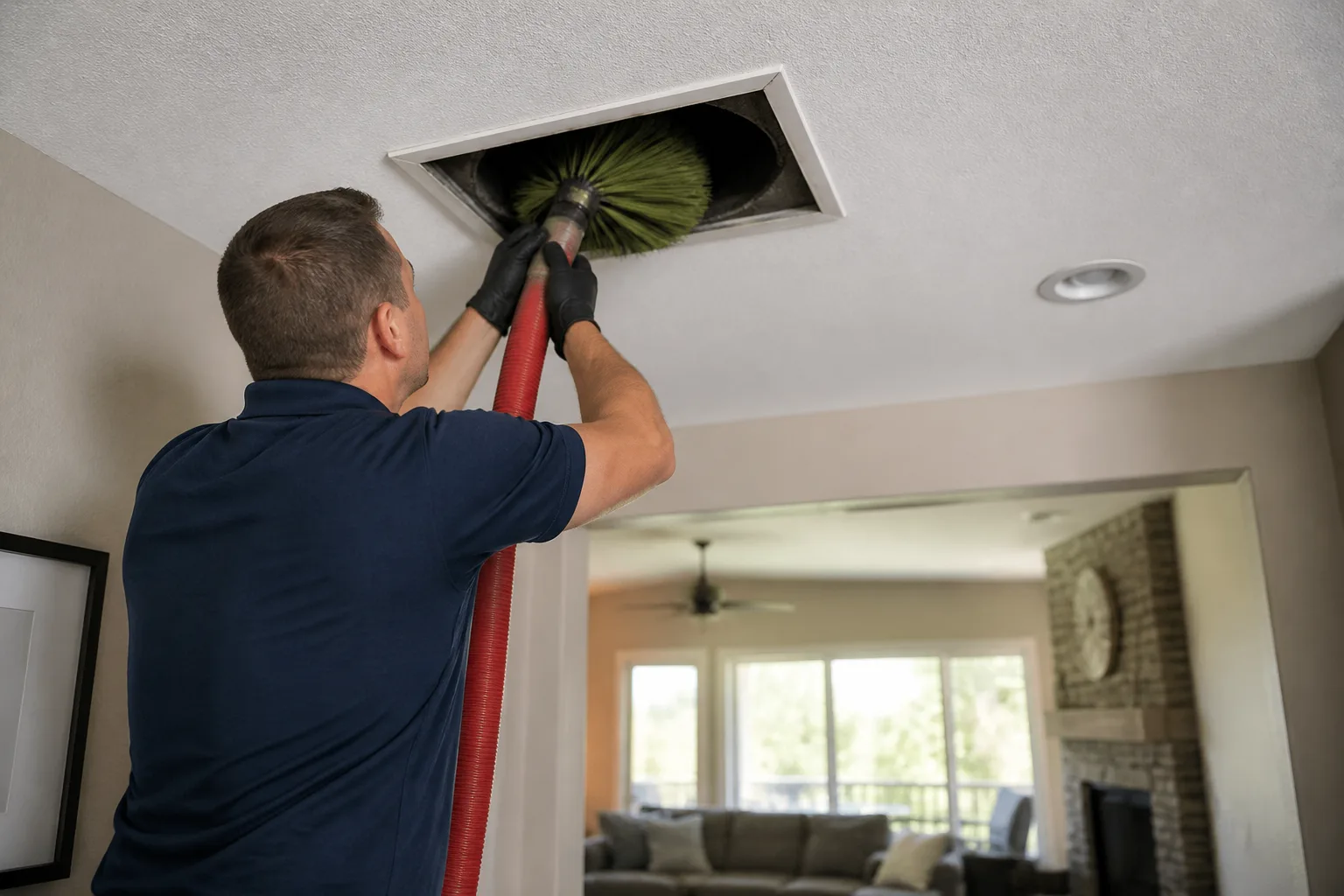
Standard rotary-brush cleaning is excellent for removing accumulated dust, pet hair, and the film that builds up over years. The Rotobrush system we run physically dislodges debris that’s adhered to the duct walls. But smoke particulate is different. It’s submicron, it’s electrostatic, and it embeds into the liner material of flex duct. Brushing alone will not get it out. What’s required is a HEPA-negative-pressure protocol that pulls the airborne fraction out while the mechanical agitation is happening, combined with the right surface treatment for the liner material. We deploy Abatement Technologies air filtration on every job we run in Redondo Beach for exactly this reason, and it’s non-negotiable on smoke calls because the filter is doing half the work.
There’s also the question of whether the flexible duct should be replaced entirely. In our experience, if the smoke exposure was brief and the ducts are relatively new, surface cleaning and fogging can be sufficient. If the exposure was heavy, or the flex duct is older and has started to absorb odor into the insulation layer, replacement is often the only way to actually eliminate the smell. A legitimate contractor will tell you that before quoting the job, not after the cleaning fails to fix the issue.
For Redondo Beach homeowners dealing with wildfire smoke from the inland hills, the same principle applies but the urgency is lower if there wasn’t direct heat or flame exposure. The air handler filter is your first check. If it’s a standard one-inch fiberglass filter, it’s doing almost nothing for smoke particulate. That’s the point where we often talk to clients about Duct Cleaning Redondo Beach services paired with a better filtration strategy, because cleaning the ducts while the filter is undersized just means re-contaminating them within a month.
What a Legitimate Emergency Response Looks Like
There’s a real difference between a company that says it handles emergencies and one that actually arrives equipped for one. The tell is in the equipment list, not the marketing copy. Here’s what we bring to an urgent contamination call in Redondo Beach:
- Nikro HEPA vacuum equipment. This is the same platform used in commercial restoration, built to capture fine particulate at the source instead of recirculating it. A warehouse-grade shop vac with a drywall filter is not a substitute.
- Rotobrush rotary-brush system. If the contamination is heavy debris like construction dust or rodent nesting material, mechanical agitation is required before vacuuming. This is source-removal methodology, not air-only cleaning.
- Abatement Technologies air filtration. On-site filtration runs during the entire cleaning process, containing what gets dislodged so it doesn’t settle on your furniture or get pulled back into the living area through return leaks.
- A clear scope conversation before any work begins. What are we cleaning, what are we replacing, and what does the written estimate include. The whole thing is set per job, not per vent.
We keep the scope tight because the goal is resolving the contamination event, not adding services you don’t need. That said, the interconnected nature of the work is real. A rodent problem that starts in a return duct frequently ends up in the dryer vent chase, because the same entry points that admit rats also provide access to the exterior vent termination. That’s one reason we handle dryer vent cleaning as part of the same call when the situation warrants it. One crew, full scope, no hand-offs to a subcontractor.
When should you stop trying to diagnose the problem yourself and call a professional? If you’ve confirmed the HVAC system is off and you can still smell the contaminant, or if you’ve opened the filter cover and seen visible material that shouldn’t be there, that’s the threshold. The cost of a wrong guess at that point is re-contamination and another full cleaning after the fact. Redondo Beach has enough older housing stock that guessing on a retrofit system is rarely cheaper than a professional assessment.
Insurance Documentation: Capturing What Matters Before Anyone Touches Anything
If you’re dealing with a contamination event in Redondo Beach, the insurance conversation starts before the cleaning does. Homeowner’s policies vary widely on how they handle rodent damage, smoke exposure, and water-related duct issues. What’s consistent is that the claims adjuster will want documentation of the condition at the time the problem was discovered, not after the remediation is complete.
Here’s what we recommend homeowners capture with a phone camera before the first technician arrives:
- Visible contamination at registers and returns. Remove the register cover if it’s easily accessible, but don’t disturb the material itself.
- The air filter condition. A filter that’s heavily loaded with dark particulate in an otherwise clean house supports the claim that the system was circulating something unusual.
- Any entry points you’ve identified. If you can see where the rodent chewed through a soffit, or where the duct tape peeled away from a boot, document it.
- The equipment nameplate. The make, model, and serial number of the air handler and the condenser help the adjuster understand what’s involved if a replacement is eventually recommended.
Written scope matters too. A contractor should provide a written description of what was found, what was done, and what was replaced. If it’s an insurable event, that document becomes part of the claim file. We’ve seen homeowners in Redondo Beach lose legitimate claims simply because the work was done without any pre-existing condition documentation, and the adjuster had no way to verify the duct damage wasn’t pre-existing. Take the photos. Keep the written estimate. It costs you five minutes and it makes the entire claim defensible.
Related services in Redondo Beach: if the contamination source is tied to your laundry room, our Redondo Beach dryer vent scope covers the full run from the drum to the exterior termination, and we’ll flag any transitions that need repair while we’re in there.
Why We Answer the Phone the Way We Do
We answer 24/7. Fast dispatch from 7am to 7pm, Sunday through Friday. When a homeowner calls us at 10pm because they’ve just smelled smoke in the return, the person who answers is the person who can walk them through the emergency sequence: turn the system off, kill the breaker, don’t open the registers. That first conversation is part of the service, not a hurdle to getting a sales appointment booked.
A call outside dispatch hours is booked into the next opening, Sunday through Friday, 7am to 7pm. We’d rather have that conversation then than have a homeowner run their blower motor all night because they thought they had to wait until business hours to get guidance. The containment principle applies at 2am the same way it applies at 2pm.
The Redondo Beach market has no shortage of duct cleaners who will quote you a low per-vent price over the phone without ever asking what’s actually in the ducts. We compete with them by doing the opposite. The equipment on the truck is the Rotobrush rotary-brush platform and Nikro HEPA extraction. The air filtration on site is Abatement Technologies. The products we use in the process include Guardsman-brand treatments where they’re relevant to the job. And the person you talk to on the first call is talking to you about source identification, because until you know what the contaminant is, you don’t know what kind of emergency you actually have.
If you’re in Redondo Beach and you’re looking at a vent that’s blowing something it shouldn’t, the sequence is always the same: shut it down, document it, call someone who’s going to talk about containment before they talk about price. That’s the difference between resolving the problem and just moving it around your house.
The Bottom Line
Emergency duct cleaning in Redondo Beach is rarely just about cleaning. The urgent part is stopping the source, containing what’s already been pulled into the system, and documenting the condition before remediation begins. Whether you’re dealing with rodent intrusion, smoke exposure, or something worse, the wrong move is the one that runs the blower motor while you’re still figuring out who to call. Turn it off at the thermostat and the breaker, photograph what you can see, and call someone who asks about the source before they quote a price. If you’re in Redondo Beach and need help, Duct Cleaning Redondo Beach offers free estimates. Call (877) 358-4828. We answer 24/7. Fast dispatch from 7am to 7pm, Sunday through Friday.
Frequently Asked Questions
There’s no flat emergency rate for Redondo Beach duct work, because the price is set per job by the written estimate after we know what we’re actually dealing with. A rodent contamination event with a full source-removal clean and some duct repair is a different job than a smoke exposure that requires HEPA-negative-pressure fogging and possible liner replacement. The estimate is free. Call (877) 358-4828 and we’ll talk through what you’re seeing and hearing before any numbers get discussed.
Because they’re quoting a different service. A per-vent price under a certain point usually means an air-only system that runs a vacuum line through the registers without mechanical agitation, or a crew that isn’t carrying HEPA extraction equipment. Source-removal with rotary-brush agitation and on-site HEPA filtration costs more because it does more. If the quote doesn’t mention the equipment method, ask. In our experience in Redondo Beach, the cheapest quote is often the most expensive outcome when the job has to be redone properly.
Ask for before-and-after documentation of the areas that were cleaned. On a rodent job, that means photos of the nesting material removed, the sections that were sealed, and the repairs that were made. On a smoke job, you should get a written scope describing what was cleaned, what was fogged, and what was replaced. A contractor who shows up with Nikro HEPA equipment and Abatement filtration is already signaling that they take documentation seriously. If they won’t show you photos of their own work, that tells you something too.
No. If the odor is coming from inside the ductwork, running the fan pulls whatever is in there through every supply register in the house. Turn the thermostat to “off” and kill the breaker for the air handler. Let the system sit until someone has assessed whether the blower can safely operate. This is the single most important thing a Redondo Beach homeowner can do during a duct emergency, and it costs nothing.
Written by the team at Duct Cleaning Redondo Beach, serving Redondo Beach since 2017.
Need Air Duct Cleaning Help?
Call Duct Cleaning Redondo Beach - licensed & insured, here with fast help in Redondo Beach.
(877) 358-4828